Latin America Bottlenecks and India Contract Shifts: Two Warning Signs in Global Shipping
Hello from OceanLook – the Eyes on the World’s Oceans!
This week in the maritime market, two major developments have drawn global attention:
congestion at key Mexican ports due to mega-vessel calls, and shifts in long-term service contracts on the India–US East Coast route.
While these may seem like isolated regional issues, they in fact signal deeper structural changes in the global supply chain—and a reset in carrier service strategies.
OceanLook has summarized the key logistics shifts that exporters and importers should be paying close attention to.
Mexico's Ports Struggling in the Era of Mega Vessels
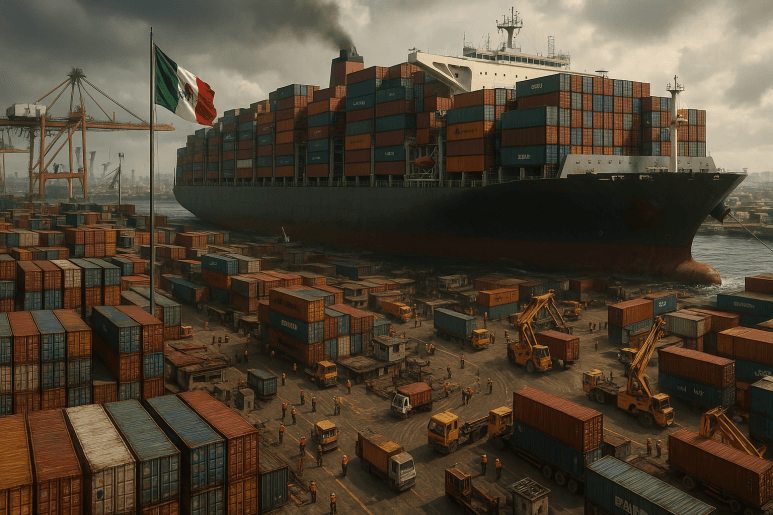
At Mexico’s main container ports—Lázaro Cárdenas and Manzanillo—vessel delays have reached up to five days due to a surge in mega-vessel calls.
Previously accustomed to 10,000 TEU ships, these ports are now receiving 12,000–16,000 TEU class vessels from carriers such as Maersk, MSC, and CMA CGM.
But port infrastructure has yet to catch up:
- Shortage of container handling equipment
- Fully booked berthing slots
- Decrease in schedule reliability
All of which are now materializing into visible congestion and bottlenecks.
The Paradox of Growth-Driven Delay

Some experts point to a broader growth in Latin American exports as the root cause behind vessel buildup.
Although carriers struggled to fill capacity in March,
certain routes are now seeing overcapacity and declining slot utilization—
creating a paradox of delays in some regions, and inefficiency in others.
India–US Service Contracts: Flexibility Over Fixity

Meanwhile, on the India–US East Coast route, a noticeable shift is underway in contracting behavior for the 2025–2026 period.
Faced with volatile market conditions, carriers and shippers are reconsidering the traditional 12–18 month fixed-rate agreements.
Key trends include:
- Major carriers like Hapag-Lloyd and MSC moving toward more FAK (Freight-All-Kinds) based contract negotiations
- Some carriers limiting long-term contracts to key accounts, and allocating the rest of the space to the spot market
- Shippers who abandon long-term deals risk losing carrier priority rights, making this a strategic balancing act
This suggests that carrier leverage may grow stronger as market uncertainty deepens.
“Flexibility Is the New Survival Strategy”

The congestion in Mexico and contract shifts on the India–US corridor are rooted in different regions and causes.
Yet they both share a common signal:
- Traditional supply chains and transport models are hitting their limits,
- and global ocean freight is shifting into a less predictable era.
So, what should logistics decision-makers do next?
OceanLook recommends the following actions:
- Closely monitor slot availability and delay trends on Latin America and North America trade lanes
- Reassess long-term contract structures and consider a hybrid approach with spot market flexibility
- Prepare contingency routing scenarios for critical lanes
“This Is the Time to Read the Signals Before They Become Obvious”

In today’s environment, securing vessel space is no longer enough.
What’s needed is data-driven forecasting, scenario planning, and real-time adaptation.
With OceanLook’s global vessel and port monitoring tools,
you can proactively detect disruptions and confidently redesign your logistics strategy.
Even when the sea is unstable, your logistics strategy doesn’t have to be.
OceanLook is here to navigate with you.
Until next timeThe OceanLook Team